
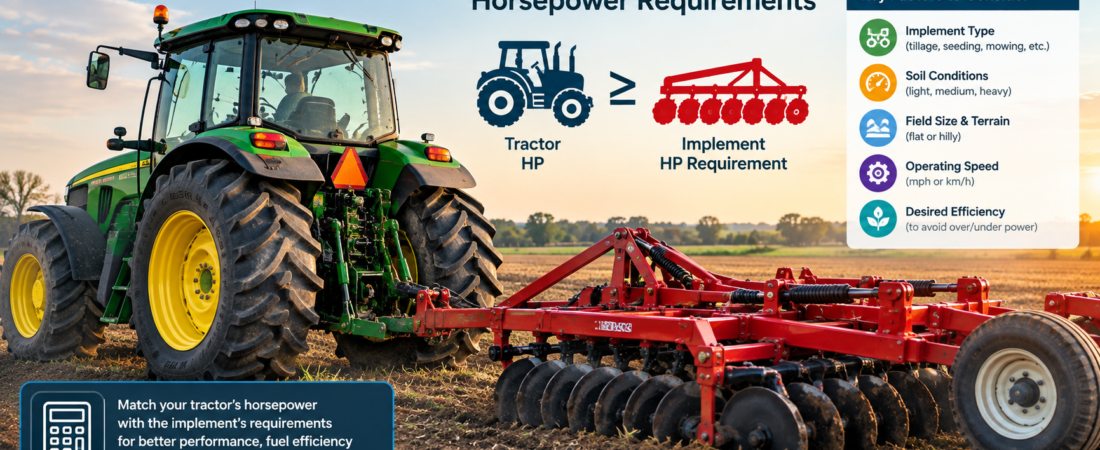
Choosing tractor horsepower for an implement is not as simple as matching two numbers. The right tractor depends on the implement’s power source, working width, soil and crop conditions, speed, terrain, hydraulic needs, and the limits listed by the manufacturers.
Quick answer
The safest starting point for tractor implement horsepower requirements is to use the exact machine and implement manuals, confirm the relevant measurements, and check the setup under the conditions in which the equipment will be used. Specifications can vary by model and configuration, so treat general explanations as guidance rather than a substitute for manufacturer instructions.
Start with the implement manual
Use the implement maker’s recommended tractor power range, minimum power, maximum power, and any weight or hitch restrictions. These details are more useful than a broad rule of thumb because designs differ between models.
For practical work, write down the model, configuration, and condition being checked. Compare like with like, and avoid assuming that a setting or measurement from another machine will transfer directly. If a specification is missing or unclear, contact the equipment manufacturer or a qualified dealer before operating outside the known limits.
PTO power versus pulling power
PTO-driven equipment uses rotating power from the PTO shaft. Pulled tools require drawbar power and enough traction to maintain a safe working speed. Some implements need both PTO power and drawbar pull, so check all stated requirements.
For practical work, write down the model, configuration, and condition being checked. Compare like with like, and avoid assuming that a setting or measurement from another machine will transfer directly. If a specification is missing or unclear, contact the equipment manufacturer or a qualified dealer before operating outside the known limits.
Working width and soil conditions
A wider tillage tool may need more pulling power, but soil type, moisture, depth, slope, residue, and travel speed can change demand substantially. Do not use a single horsepower-per-foot estimate as a substitute for the manufacturer’s guidance.
For practical work, write down the model, configuration, and condition being checked. Compare like with like, and avoid assuming that a setting or measurement from another machine will transfer directly. If a specification is missing or unclear, contact the equipment manufacturer or a qualified dealer before operating outside the known limits.
Weight, ballast, and traction
A tractor may have enough engine power yet struggle to transfer that power to the ground. Wheel slip, tire choice, ballast, axle limits, and stability matter. Add ballast only as instructed by the tractor manufacturer.
For practical work, write down the model, configuration, and condition being checked. Compare like with like, and avoid assuming that a setting or measurement from another machine will transfer directly. If a specification is missing or unclear, contact the equipment manufacturer or a qualified dealer before operating outside the known limits.
Hydraulics, hitch, and electrical needs
Horsepower is only one part of compatibility. An implement may also need hydraulic flow, remote valves, a three-point hitch capacity, electrical connections, ISOBUS, or a particular PTO speed.
For practical work, write down the model, configuration, and condition being checked. Compare like with like, and avoid assuming that a setting or measurement from another machine will transfer directly. If a specification is missing or unclear, contact the equipment manufacturer or a qualified dealer before operating outside the known limits.
Recognize signs of mismatch
Repeated engine lugging, excessive wheel slip, poor work quality, overheating, or inability to maintain the recommended speed can signal a mismatch or incorrect setup. Stop and check the manuals rather than forcing the machine.
For practical work, write down the model, configuration, and condition being checked. Compare like with like, and avoid assuming that a setting or measurement from another machine will transfer directly. If a specification is missing or unclear, contact the equipment manufacturer or a qualified dealer before operating outside the known limits.
Power estimates are not guarantees
Online calculators can provide a starting point, but they cannot know every field condition or machine limitation. Treat their results as estimates and confirm the selected combination with manufacturer data.
A practical purchase worksheet
Record the implement model, minimum and maximum tractor power, required PTO speed, hydraulic circuits, hitch type, weight, and transport restrictions. Ask the dealer to confirm any unknowns in writing.
Practical example
Two implements with the same working width can have different power requirements because of design, working depth, soil contact, and operating speed. Compare the exact model specifications and the conditions in which the implement will be used.
This example explains the decision process; it is not a model-specific setting or a promise of performance. Use measured values from your own machine and follow the manufacturer’s approved procedure.
Common mistakes to avoid
Using a specification from a different model or configuration without checking compatibility.
Changing several settings at once, which makes it hard to identify the cause of a result.
Ignoring warning lights, damaged guards, leaks, unusual heat, or other signs that equipment needs inspection.
Assuming a display reading is correct without checking the sensor, inputs, calibration, or manual.
Step-by-step checklist
- Find the implement’s approved tractor power range.
- Determine whether PTO, drawbar, or both power types are needed.
- Check hitch, weight, hydraulic, electrical, and PTO requirements.
- Consider terrain, soil, moisture, depth, and working speed.
- Confirm safe ballast and tire setup using the tractor manual.
Records that make the next job easier
Keep a short record of the machine model, implement model, date, operating conditions, measurements, settings, and any changes made. Note whether a value came from a manufacturer specification, a measurement, or an estimate. This distinction helps prevent an estimate from being mistaken for an official rating.
When the same task is repeated, compare records from similar conditions. A result from wet soil, a different crop, or another implement may not be a fair comparison. Records are also useful when another operator takes over the machine or when a dealer helps diagnose a problem.
Safety and maintenance notes
Park securely, shut down and isolate the machine before maintenance, and follow the operator manual. Do not use hands to locate hydraulic leaks or work near moving components. High-pressure fluid injuries require emergency medical attention.
Stop work if a guard is missing, a hose or fitting is damaged, a warning indicates a serious fault, or the machine behaves unexpectedly. Use qualified service for repairs that exceed your training, tools, or the manufacturer’s permitted operator maintenance.
Frequently asked questions
Can a tractor have too much horsepower for an implement?
Yes, if its power, speed, weight, or operating capability exceeds the implement’s approved limits. Follow the implement maker’s maximum ratings.
Is horsepower the only compatibility factor?
No. Hitch capacity, stability, hydraulics, PTO speed, weight, and control compatibility are also important.
Should I size for the hardest field?
Plan for realistic conditions and follow manufacturer guidance; do not exceed the machine’s ratings to handle difficult conditions.
Helpful resources
Start with the operator and service manuals for the exact machine and implement. General safety information is available from the U.S. Occupational Safety and Health Administration (OSHA), Penn State Extension, and eXtension’s agricultural safety resources. Use a specific official page that directly supports the point you are checking, and confirm the guidance applies to your equipment and location.
Explore more equipment and maintenance guides at AGRO Function.
How to use this guide
Use this article as a starting checklist, then verify details against the current manual. Machine generations can differ even when model names look similar. If the manual conflicts with a general article, follow the manufacturer’s instructions and contact its support team when needed.
For tractor implement horsepower requirements, the practical question is not only what a specification says but also how it was measured and which configuration it describes. Write down the source of the value, its units, and any stated limits. This small habit makes future decisions easier to review and reduces the chance of comparing unlike machines.
What can change the result — field notes
The same setup can behave differently when the load, soil, crop, moisture, terrain, travel speed, temperature, or machine condition changes. Record those conditions whenever you compare results. This makes your notes more useful than a single number without context.
When to get expert help — planning notes
Ask a qualified technician or equipment dealer when a specification is missing, a safety system does not work, measurements are outside the stated range, or a repair involves pressure, stored energy, rotating parts, or structural components. Do not guess at a setting that could damage equipment or injure someone.
For tractor implement horsepower requirements, the practical question is not only what a specification says but also how it was measured and which configuration it describes. Write down the source of the value, its units, and any stated limits. This small habit makes future decisions easier to review and reduces the chance of comparing unlike machines.
How to use this guide — verification tips
Use this article as a starting checklist, then verify details against the current manual. Machine generations can differ even when model names look similar. If the manual conflicts with a general article, follow the manufacturer’s instructions and contact its support team when needed.
What can change the result — record keeping
The same setup can behave differently when the load, soil, crop, moisture, terrain, travel speed, temperature, or machine condition changes. Record those conditions whenever you compare results. This makes your notes more useful than a single number without context.
For tractor implement horsepower requirements, the practical question is not only what a specification says but also how it was measured and which configuration it describes. Write down the source of the value, its units, and any stated limits. This small habit makes future decisions easier to review and reduces the chance of comparing unlike machines.
When to get expert help
Ask a qualified technician or equipment dealer when a specification is missing, a safety system does not work, measurements are outside the stated range, or a repair involves pressure, stored energy, rotating parts, or structural components. Do not guess at a setting that could damage equipment or injure someone.
How to use this guide — field notes
Use this article as a starting checklist, then verify details against the current manual. Machine generations can differ even when model names look similar. If the manual conflicts with a general article, follow the manufacturer’s instructions and contact its support team when needed.
For tractor implement horsepower requirements, the practical question is not only what a specification says but also how it was measured and which configuration it describes. Write down the source of the value, its units, and any stated limits. This small habit makes future decisions easier to review and reduces the chance of comparing unlike machines.
What can change the result — planning notes
The same setup can behave differently when the load, soil, crop, moisture, terrain, travel speed, temperature, or machine condition changes. Record those conditions whenever you compare results. This makes your notes more useful than a single number without context.
When to get expert help — verification tips
Ask a qualified technician or equipment dealer when a specification is missing, a safety system does not work, measurements are outside the stated range, or a repair involves pressure, stored energy, rotating parts, or structural components. Do not guess at a setting that could damage equipment or injure someone.
For tractor implement horsepower requirements, the practical question is not only what a specification says but also how it was measured and which configuration it describes. Write down the source of the value, its units, and any stated limits. This small habit makes future decisions easier to review and reduces the chance of comparing unlike machines.
How to use this guide — record keeping
Use this article as a starting checklist, then verify details against the current manual. Machine generations can differ even when model names look similar. If the manual conflicts with a general article, follow the manufacturer’s instructions and contact its support team when needed.
What can change the result
The same setup can behave differently when the load, soil, crop, moisture, terrain, travel speed, temperature, or machine condition changes. Record those conditions whenever you compare results. This makes your notes more useful than a single number without context.
For tractor implement horsepower requirements, the practical question is not only what a specification says but also how it was measured and which configuration it describes. Write down the source of the value, its units, and any stated limits. This small habit makes future decisions easier to review and reduces the chance of comparing unlike machines.
When to get expert help — field notes
Ask a qualified technician or equipment dealer when a specification is missing, a safety system does not work, measurements are outside the stated range, or a repair involves pressure, stored energy, rotating parts, or structural components. Do not guess at a setting that could damage equipment or injure someone.