
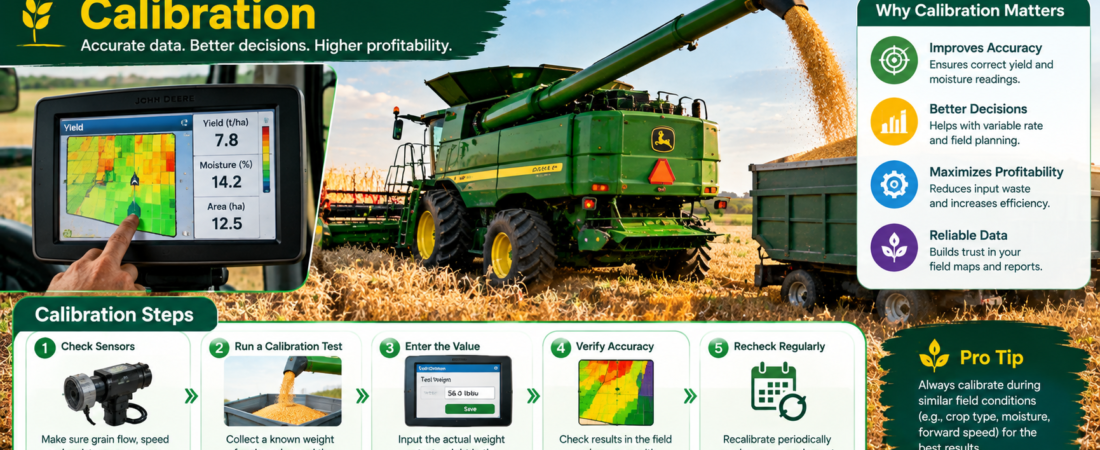
A combine yield monitor estimates crop flow and helps create yield maps. Calibration is important because sensor readings can be affected by crop type, moisture, machine settings, and harvest conditions. A map is only useful when its data are collected and interpreted carefully.
Quick answer
The safest starting point for combine yield monitor calibration is to use the exact machine and implement manuals, confirm the relevant measurements, and check the setup under the conditions in which the equipment will be used. Specifications can vary by model and configuration, so treat general explanations as guidance rather than a substitute for manufacturer instructions.
Know what the monitor measures
Yield monitors commonly combine crop-flow information with moisture, speed, position, and header-width data. Sensor types differ, so use the manual for the exact combine and display.
For practical work, write down the model, configuration, and condition being checked. Compare like with like, and avoid assuming that a setting or measurement from another machine will transfer directly. If a specification is missing or unclear, contact the equipment manufacturer or a qualified dealer before operating outside the known limits.
Prepare before calibration
Check clean sensors, correct crop settings, header-width input, moisture sensor status, GPS reception, and time/date settings. Repair faults before calibrating.
For practical work, write down the model, configuration, and condition being checked. Compare like with like, and avoid assuming that a setting or measurement from another machine will transfer directly. If a specification is missing or unclear, contact the equipment manufacturer or a qualified dealer before operating outside the known limits.
Use representative loads
Calibration procedures often compare monitor estimates with a known harvested weight. Follow the manufacturer’s prescribed method and use representative crop conditions.
For practical work, write down the model, configuration, and condition being checked. Compare like with like, and avoid assuming that a setting or measurement from another machine will transfer directly. If a specification is missing or unclear, contact the equipment manufacturer or a qualified dealer before operating outside the known limits.
Calibrate by crop and conditions
Different crops and conditions can affect readings differently. Some systems require separate calibrations for each crop or changes in crop flow.
For practical work, write down the model, configuration, and condition being checked. Compare like with like, and avoid assuming that a setting or measurement from another machine will transfer directly. If a specification is missing or unclear, contact the equipment manufacturer or a qualified dealer before operating outside the known limits.
Avoid common data errors
Incorrect field boundaries, wrong crop selection, poor GPS, partial header width, and overlapping passes can distort maps even when the flow sensor is calibrated.
For practical work, write down the model, configuration, and condition being checked. Compare like with like, and avoid assuming that a setting or measurement from another machine will transfer directly. If a specification is missing or unclear, contact the equipment manufacturer or a qualified dealer before operating outside the known limits.
Review and document results
Keep notes about crop, moisture, calibration loads, scale source, and settings. Follow the display manual when recalibration is required.
For practical work, write down the model, configuration, and condition being checked. Compare like with like, and avoid assuming that a setting or measurement from another machine will transfer directly. If a specification is missing or unclear, contact the equipment manufacturer or a qualified dealer before operating outside the known limits.
Keep calibration records
Record crop, moisture range, test weights, and the monitor’s calibration factor or procedure as allowed by the system. Records make it easier to understand changes between fields and seasons.
Do not confuse calibration with cleaning data
Calibration adjusts measurement response; cleaning data removes invalid records. Follow the mapping software’s documentation for both processes.
Practical example
If a monitor reports a harvested amount that differs from a reliable weigh-ticket total, follow the calibration procedure rather than manually changing numbers without a documented method.
This example explains the decision process; it is not a model-specific setting or a promise of performance. Use measured values from your own machine and follow the manufacturer’s approved procedure.
Common mistakes to avoid
Using a specification from a different model or configuration without checking compatibility.
Changing several settings at once, which makes it hard to identify the cause of a result.
Ignoring warning lights, damaged guards, leaks, unusual heat, or other signs that equipment needs inspection.
Assuming a display reading is correct without checking the sensor, inputs, calibration, or manual.
Step-by-step checklist
- Check the manual for the exact monitor model.
- Inspect sensors and confirm crop and header settings.
- Use representative calibration loads and reliable weights.
- Confirm GPS, field boundaries, and moisture settings.
- Record the calibration date and conditions.
Records that make the next job easier
Keep a short record of the machine model, implement model, date, operating conditions, measurements, settings, and any changes made. Note whether a value came from a manufacturer specification, a measurement, or an estimate. This distinction helps prevent an estimate from being mistaken for an official rating.
When the same task is repeated, compare records from similar conditions. A result from wet soil, a different crop, or another implement may not be a fair comparison. Records are also useful when another operator takes over the machine or when a dealer helps diagnose a problem.
Safety and maintenance notes
Park securely, shut down and isolate the machine before maintenance, and follow the operator manual. Do not use hands to locate hydraulic leaks or work near moving components. High-pressure fluid injuries require emergency medical attention.
Stop work if a guard is missing, a hose or fitting is damaged, a warning indicates a serious fault, or the machine behaves unexpectedly. Use qualified service for repairs that exceed your training, tools, or the manufacturer’s permitted operator maintenance.
Frequently asked questions
How often should a yield monitor be calibrated?
Follow the manufacturer’s schedule and recalibrate when the manual calls for it, such as after crop or operating-condition changes.
Can calibration fix a bad yield map?
It may correct measurement error, but GPS, field boundaries, header width, and data logging can also cause map problems.
Can I use one calibration for all crops?
Only if the manufacturer says the system supports it. Many systems need crop-specific calibration.
Helpful resources
Start with the operator and service manuals for the exact machine and implement. General safety information is available from the U.S. Occupational Safety and Health Administration (OSHA), Penn State Extension, and eXtension’s agricultural safety resources. Use a specific official page that directly supports the point you are checking, and confirm the guidance applies to your equipment and location.
Explore more equipment and maintenance guides at AGRO Function.
How to use this guide
Use this article as a starting checklist, then verify details against the current manual. Machine generations can differ even when model names look similar. If the manual conflicts with a general article, follow the manufacturer’s instructions and contact its support team when needed.
For combine yield monitor calibration, the practical question is not only what a specification says but also how it was measured and which configuration it describes. Write down the source of the value, its units, and any stated limits. This small habit makes future decisions easier to review and reduces the chance of comparing unlike machines.
What can change the result — field notes
The same setup can behave differently when the load, soil, crop, moisture, terrain, travel speed, temperature, or machine condition changes. Record those conditions whenever you compare results. This makes your notes more useful than a single number without context.
When to get expert help — planning notes
Ask a qualified technician or equipment dealer when a specification is missing, a safety system does not work, measurements are outside the stated range, or a repair involves pressure, stored energy, rotating parts, or structural components. Do not guess at a setting that could damage equipment or injure someone.
For combine yield monitor calibration, the practical question is not only what a specification says but also how it was measured and which configuration it describes. Write down the source of the value, its units, and any stated limits. This small habit makes future decisions easier to review and reduces the chance of comparing unlike machines.
How to use this guide — verification tips
Use this article as a starting checklist, then verify details against the current manual. Machine generations can differ even when model names look similar. If the manual conflicts with a general article, follow the manufacturer’s instructions and contact its support team when needed.
What can change the result — record keeping
The same setup can behave differently when the load, soil, crop, moisture, terrain, travel speed, temperature, or machine condition changes. Record those conditions whenever you compare results. This makes your notes more useful than a single number without context.
For combine yield monitor calibration, the practical question is not only what a specification says but also how it was measured and which configuration it describes. Write down the source of the value, its units, and any stated limits. This small habit makes future decisions easier to review and reduces the chance of comparing unlike machines.
When to get expert help
Ask a qualified technician or equipment dealer when a specification is missing, a safety system does not work, measurements are outside the stated range, or a repair involves pressure, stored energy, rotating parts, or structural components. Do not guess at a setting that could damage equipment or injure someone.
How to use this guide — field notes
Use this article as a starting checklist, then verify details against the current manual. Machine generations can differ even when model names look similar. If the manual conflicts with a general article, follow the manufacturer’s instructions and contact its support team when needed.
For combine yield monitor calibration, the practical question is not only what a specification says but also how it was measured and which configuration it describes. Write down the source of the value, its units, and any stated limits. This small habit makes future decisions easier to review and reduces the chance of comparing unlike machines.
What can change the result — planning notes
The same setup can behave differently when the load, soil, crop, moisture, terrain, travel speed, temperature, or machine condition changes. Record those conditions whenever you compare results. This makes your notes more useful than a single number without context.
When to get expert help — verification tips
Ask a qualified technician or equipment dealer when a specification is missing, a safety system does not work, measurements are outside the stated range, or a repair involves pressure, stored energy, rotating parts, or structural components. Do not guess at a setting that could damage equipment or injure someone.
For combine yield monitor calibration, the practical question is not only what a specification says but also how it was measured and which configuration it describes. Write down the source of the value, its units, and any stated limits. This small habit makes future decisions easier to review and reduces the chance of comparing unlike machines.
How to use this guide — record keeping
Use this article as a starting checklist, then verify details against the current manual. Machine generations can differ even when model names look similar. If the manual conflicts with a general article, follow the manufacturer’s instructions and contact its support team when needed.
What can change the result
The same setup can behave differently when the load, soil, crop, moisture, terrain, travel speed, temperature, or machine condition changes. Record those conditions whenever you compare results. This makes your notes more useful than a single number without context.
For combine yield monitor calibration, the practical question is not only what a specification says but also how it was measured and which configuration it describes. Write down the source of the value, its units, and any stated limits. This small habit makes future decisions easier to review and reduces the chance of comparing unlike machines.