
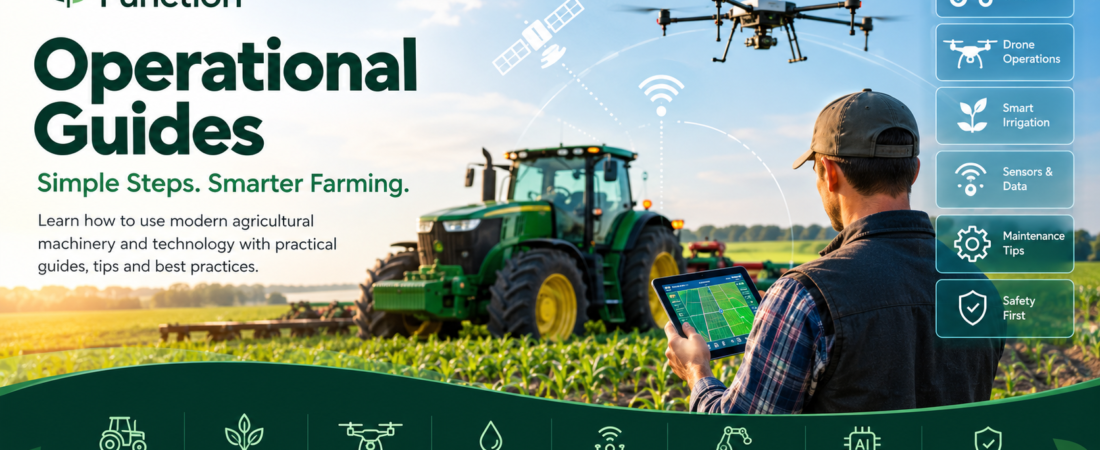
Modern farming is changing fast.
Today, farmers have access to tractors with GPS, autonomous machines, agricultural drones, smart irrigation systems, soil sensors, robots, artificial intelligence, and many other technologies.
These tools can make farming faster and more efficient. But buying modern equipment is only the beginning.
Knowing how to use it properly is just as important.
That is where operational guides can help.
An operational guide explains how to use a machine, system, or agricultural technology in a simple and practical way. It can show farmers what to do before starting, how to operate the equipment, how to maintain it, and what to check if something goes wrong.
At AGRO Function, we aim to make modern agricultural technology easier to understand and easier to use.
What Is an Operational Guide?
An operational guide is basically a how-to guide for agricultural equipment or technology.
It takes something that may look complicated and breaks it down into simple steps.
For example, a guide for a modern tractor might explain:
- How to prepare the tractor
- How to start it
- How to connect an implement
- How to use different controls
- How to set the correct speed
- How to use GPS guidance
- How to check the machine during operation
- How to perform basic maintenance
The same idea can be used for almost any agricultural technology.
A drone guide may explain how to prepare the drone, plan a flight, check the batteries, collect images, and safely finish the operation.
A smart irrigation guide may explain how to install sensors, set watering schedules, check soil moisture, and monitor water use.
The goal is simple:
Make technology easier to use.
Why Are Operational Guides Important?
Agricultural machines are becoming more advanced.
A modern tractor, for example, may have GPS, automatic steering, touchscreen controls, cameras, sensors, and systems that can collect information while the machine is working.
For someone who has never used this type of equipment, all these features can feel confusing.
A good operational guide removes some of that confusion.
It tells the operator what to do and, just as importantly, what not to do.
This is especially important because using equipment incorrectly can lead to:
- Poor performance
- Higher fuel or energy use
- Unnecessary wear
- Damaged equipment
- Crop losses
- Wasted inputs
- Safety problems
The Food and Agriculture Organization of the United Nations (FAO) notes that digital and automated technologies can improve agricultural efficiency and productivity, but cost, skills, knowledge, and infrastructure can affect their adoption.
In other words, technology works best when people know how to use it.
Start by Understanding the Machine
Before using any agricultural machine, first understand what it is designed to do.
Every machine has a specific job.
A tractor is mainly used to provide power and pull or operate different implements.
A combine harvester is designed to harvest crops.
A planter is designed to place seeds in the soil.
A sprayer is used to apply agricultural products.
A drone may be used for crop monitoring, mapping, or other agricultural applications.
Understanding the machine’s main purpose makes it easier to understand its controls and settings.
Before operation, learn the basic specifications.
These may include:
- Engine or motor power
- Fuel or battery type
- Operating capacity
- Working width
- Weight
- Maximum speed
- Hydraulic capacity
- Compatible implements
- Battery capacity
- Control systems
You do not need to memorize every specification.
The important thing is to understand what the machine can do and what it is designed for.
Read the Manufacturer’s Manual
One of the simplest things an operator can do is also one of the most important:
Read the manual.
The manufacturer’s manual contains information specific to that machine.
Different machines can have different controls, settings, maintenance requirements, and safety systems.
Even if two tractors look similar, they may not operate in exactly the same way.
Before using a machine for the first time, learn:
- Where the main controls are
- How to start and stop the machine
- What the warning lights mean
- How to adjust important settings
- How to use emergency controls
- What maintenance is required
- What safety systems are installed
For machines with digital displays, also spend some time learning the screen.
Modern agricultural equipment may show information such as speed, fuel consumption, engine condition, GPS position, implement settings, warnings, and maintenance reminders.
Understanding these displays can make daily operation much easier.
Check the Machine Before Starting
A quick inspection before work can prevent many problems later.
Before starting the machine, check the areas recommended by the manufacturer.
Depending on the equipment, this may include:
- Engine oil
- Coolant
- Fuel
- Hydraulic fluid
- Tires
- Battery
- Belts
- Hoses
- Filters
- Brakes
- Lights
- Safety guards
- Electrical connections
Also check the equipment attached to the machine.
For example, if a tractor is connected to a planter, sprayer, mower, or other implement, make sure the connection is secure.
Look for loose parts, leaks, damaged components, or anything that does not look normal.
This simple inspection can save time and money later.
Check the Working Area
Checking the machine is only part of preparation.
You should also check the area where the machine will operate.
Look for things such as:
- Rocks
- Holes
- Fences
- Trees
- Animals
- People
- Power lines
- Water channels
- Uneven ground
- Other machinery
This is especially important when using large machines or autonomous equipment.
The operator should know where the machine will travel and what could be in its path.
Good preparation makes operation safer and smoother.
Starting the Machine
Starting agricultural machinery may look easy, but it should always be done according to the manufacturer’s instructions.
Before starting, make sure the operator’s area is clear.
Once the machine starts, pay attention to anything unusual.
For example:
- Strange sounds
- Excessive vibration
- Warning lights
- Smoke
- Fluid leaks
- Unusual smells
Do not ignore warning signs.
If something does not look or sound right, stop safely and investigate the problem.
A small problem can become a much bigger and more expensive problem if the machine continues working.
Operating Agricultural Machinery
Once the machine is ready, the next step is actual operation.
The correct operating method depends on the type of machine and the job.
For example, a tractor operator may need to select the correct gear, engine speed, hydraulic settings, and implement settings.
A planter may require adjustments for:
- Seed type
- Planting depth
- Row spacing
- Seed rate
- Ground speed
- Soil conditions
A sprayer may require attention to:
- Application rate
- Travel speed
- Nozzle type
- Pressure
- Boom height
- Weather conditions
The important thing is to use the correct settings for the job.
Going faster does not always mean getting more work done.
Operating too quickly can reduce accuracy and increase fuel use and equipment wear.
Using GPS and Precision Agriculture
GPS and precision agriculture have changed the way many farmers work.
Modern guidance systems can help machines follow planned routes and reduce unnecessary overlap.
FAO describes precision agriculture as an approach that uses technologies such as positioning systems, sensors, drones, mapping, and variable-rate systems to make farming decisions more accurately.
A GPS-guided tractor, for example, may require the operator to:
- Turn on the guidance system.
- Check the GPS signal.
- Set the field or guidance line.
- Enter the correct implement width.
- Check the guidance settings.
- Start field operation.
- Monitor the system while working.
Correct setup is important.
If the implement width is entered incorrectly, for example, the machine may create unnecessary overlaps or leave gaps.
A few minutes of setup can make a big difference over a large field.
Operating Agricultural Drones
Agricultural drones are becoming useful tools for modern farming.
They can be used for activities such as:
- Crop monitoring
- Field mapping
- Plant health observation
- Imaging
- Data collection
Before operating a drone, the operator should inspect the equipment and make sure the batteries, propellers, controller, sensors, and other components are ready.
The flight area should also be checked.
Depending on the task, the operator may need to set:
- Flight altitude
- Flight speed
- Flight path
- Camera settings
- Mapping area
- Battery limits
- Return-to-home settings
Drone operators should also follow all applicable aviation, agricultural, and product-use regulations.
The exact rules depend on the location and type of operation.
Smart Irrigation Systems
Water is one of the most important resources on a farm.
Modern irrigation systems can use sensors, controllers, weather information, pumps, and automated valves to manage water more efficiently.
A smart irrigation system may monitor soil moisture and automatically adjust irrigation according to programmed settings.
An operational guide should explain how to:
- Install sensors
- Connect the controller
- Create irrigation zones
- Set schedules
- Monitor soil moisture
- Check water flow
- Adjust settings
- Find common problems
Automation can save time, but it still needs supervision.
A sensor can fail.
A valve can become blocked.
A pump can stop working.
A communication connection can be lost.
Farmers should regularly check that the system is working as expected.
Using Agricultural Sensors
Sensors are becoming common on modern farms.
They can measure things such as:
- Soil moisture
- Temperature
- Humidity
- Water flow
- Weather conditions
- Crop conditions
But collecting data is only useful if the data is reliable.
Sensors need to be installed correctly and checked regularly.
Farmers should also understand what the numbers mean.
For example, a soil moisture reading should not be viewed by itself.
The reading may need to be considered along with:
- Soil type
- Crop type
- Weather
- Irrigation method
- Crop growth stage
Good farming decisions come from understanding the data, not simply collecting it.
Autonomous and Robotic Farm Equipment
Automation is another major development in agriculture.
Some modern machines can perform tasks with limited direct control from the operator.
Agricultural robots can be used for tasks such as:
- Weeding
- Crop monitoring
- Transport
- Harvesting
- Field inspection
These machines require careful setup.
Operators should understand:
- Operating boundaries
- Navigation systems
- Obstacle detection
- Emergency stop functions
- Remote controls
- Battery or fuel requirements
- Software settings
Before using autonomous equipment, operators should know how to stop the machine if something unexpected happens.
Automation can reduce labor requirements, but safety and supervision are still important.
Maintenance Is Part of Operation
A machine cannot perform well if it is not maintained.
Regular maintenance helps reduce breakdowns and can extend the useful life of equipment.
Depending on the machine, maintenance may include:
- Changing oil
- Replacing filters
- Checking hydraulic fluid
- Lubricating moving parts
- Checking belts
- Checking tires
- Cleaning sensors
- Inspecting electrical connections
- Checking batteries
- Updating software
Always follow the manufacturer’s recommended maintenance schedule.
It is also a good idea to keep maintenance records.
A simple record can show:
- When maintenance was performed
- What was replaced
- How many hours the machine had worked
- What problems were found
This information can become very useful over time.
What to Do When Something Goes Wrong
Even well-maintained equipment can have problems.
A machine may:
- Fail to start
- Lose power
- Overheat
- Show a warning message
- Make unusual noises
- Use more fuel than normal
- Lose GPS signal
- Stop communicating with sensors
- Experience battery problems
The first step is to stop and identify the problem safely.
Do not continue operating a machine simply because it still moves.
Check the manufacturer’s troubleshooting information.
Some problems may be simple to fix.
Others may require a trained technician.
Trying to repair a complicated machine without the right knowledge can cause additional damage or create a safety risk.
Safety Comes First
Agricultural machinery can be extremely powerful.
That means safety should always be part of an operational guide.
Operators should follow the safety instructions provided by the manufacturer and use appropriate protective equipment.
Important safety practices include:
- Keep people away from moving machinery.
- Never bypass safety systems.
- Do not operate machinery when extremely tired or impaired.
- Stop equipment before performing maintenance when required.
- Keep loose clothing away from moving parts.
- Be careful around rotating components.
- Pay attention to people, animals, and obstacles.
- Follow safe operating practices on slopes.
- Know how to use emergency stops.
For tractors, NIOSH recommends the use of rollover protective structures (ROPS) and seat belts as important safety measures.
Safety requirements can vary between machines and locations, so always follow the manufacturer’s instructions and applicable local regulations.
Training New Operators
New technology requires proper training.
A person should not be expected to understand an advanced machine simply because they know how to operate a basic one.
Training should begin with the basics.
A simple training process could look like this:
Step 1: Understand the machine
Learn what it does and what it is designed for.
Step 2: Learn the controls
Understand the main buttons, levers, displays, and safety systems.
Step 3: Learn safety procedures
Know the major risks and emergency procedures.
Step 4: Watch an experienced operator
See how the equipment is used in real conditions.
Step 5: Practice
Operate the machine under supervision.
Step 6: Learn basic troubleshooting
Understand common warnings and problems.
Step 7: Operate independently
Only after the operator has demonstrated the necessary skills.
Good training can improve confidence while reducing mistakes.
Use Technology for a Real Purpose
Modern technology can be impressive.
But farmers should not buy technology simply because it is new.
The most useful technology is technology that solves a real problem.
Before investing in new equipment, ask:
- What problem does it solve?
- How often will we use it?
- How much does it cost?
- What are the running costs?
- How much training is required?
- Is technical support available?
- Can it work with our existing equipment?
- What results can we realistically expect?
A more expensive machine is not automatically a better choice.
The right machine is the one that provides useful results for the farm.
Managing Data From Farm Technology
Modern machines can generate a lot of information.
A tractor may record fuel use and field data.
A combine may record yield information.
Sensors can collect soil and weather data.
Drones can create images and maps.
This information can help farmers make better decisions.
FAO highlights the growing role of digital technologies, data, remote sensing, and other tools in improving agricultural decision-making.
But collecting data is only the first step.
Farmers need to understand and use it.
For example, yield maps can help identify areas of a field that perform differently.
Soil data can help identify areas that may need different management.
Machine data can help identify inefficient operations.
Over time, this information can help farmers improve their decisions.
How to Improve Operational Efficiency
One of the biggest benefits of agricultural technology is better efficiency.
Efficiency can mean:
- Using less fuel
- Using less water
- Reducing labor
- Reducing overlap
- Improving planting accuracy
- Reducing crop losses
- Finishing fieldwork faster
- Reducing unnecessary equipment wear
For example, GPS guidance can help reduce unnecessary overlap between passes.
A properly calibrated planter can improve seed placement.
A smart irrigation system can help deliver water based on actual field conditions.
The goal is not simply to use technology.
The goal is to use technology to get better results.
What Makes a Good Operational Guide?
A good operational guide should be easy to follow.
It should not feel like a complicated technical manual.
A simple structure works well:
1. Introduction
Explain what the machine or technology does.
2. Main Features
Explain the most important features.
3. Before You Start
List the checks that should be completed.
4. Setup
Explain how to prepare the equipment.
5. Operation
Give clear instructions for using it.
6. Safety
Explain the most important safety points.
7. Maintenance
Explain basic maintenance requirements.
8. Troubleshooting
Cover common problems.
9. Best Practices
Give practical tips.
10. Final Checklist
Provide a short checklist before the operator finishes.
This structure works for everything from tractors and harvesters to drones, sensors, irrigation systems, and agricultural robots.
The Future of Agricultural Operations
Agriculture is becoming more connected.
Machines, sensors, drones, satellites, software, artificial intelligence, and robots are increasingly working together.
In the future, farmers may be able to manage many parts of their operation through connected digital platforms.
A sensor could detect a change in soil conditions.
Software could analyze the information.
An AI system could help identify possible actions.
A machine could then carry out part of the task automatically.
FAO’s recent work on smart farming describes how data, digital technology, AI, IoT, and precision agriculture are being combined to improve farm management and resource use.
This does not mean farmers will become less important.
Instead, their role may change.
Farmers may spend less time controlling every individual machine and more time managing information, making decisions, checking results, and improving the overall farm operation.
AGRO Function and Operational Guides
At AGRO Function, we believe agricultural technology should be easy to understand.
Our goal is to explain modern farming technology in a way that is useful for real people.
That means focusing on practical questions:
What does this technology do?
How does it work?
How do you use it?
What should you check before using it?
What can go wrong?
How can you maintain it?
How can you use it more efficiently?
We cover modern agricultural equipment and technologies including machinery, precision agriculture, drones, automation, smart farming, sensors, robotics, AI, and other technologies shaping the future of agriculture.
You can explore more agricultural technology resources on AGRO Function.
Final Thoughts
Agricultural technology is becoming more powerful every year.
Farmers now have access to machines and systems that can make farming faster, more accurate, and more efficient.
But advanced technology is only useful when it is used correctly.
A GPS system needs the right settings.
A drone needs proper preparation.
A sensor needs to be installed correctly.
An irrigation system needs regular monitoring.
A tractor needs proper operation and maintenance.
And every machine needs to be used safely.
That is why operational guides are so important.
They take complicated technology and turn it into simple, practical information.
At AGRO Function, our goal is to make that information easier to find and easier to understand.
Whether you are a farmer, farm manager, agricultural professional, student, machinery operator, or simply interested in the future of farming, understanding how agricultural technology works can help you make better decisions.
The future of agriculture will not be built by technology alone.
It will be built by people who know how to use that technology effectively.
Explore more at AGRO Function.
Useful Agricultural Technology Resources
For readers who want to learn more, these organizations provide reliable information about agricultural technology, digital agriculture, and farm safety:
- FAO – Agro-Informatics — Information about agricultural data, digital tools, remote sensing, and geospatial technologies.
- FAO – Digital Agriculture — Resources covering digital technologies and their role in agriculture.
- FAO – Smart Farming — Information about smart farming, technology, resource management, and modern agricultural practices.
- CDC/NIOSH – Agricultural Safety — Agricultural machinery and tractor safety information.
Important: Operational guides should supplement—not replace—the manufacturer’s official manual, training, safety instructions, and applicable laws or regulations.