
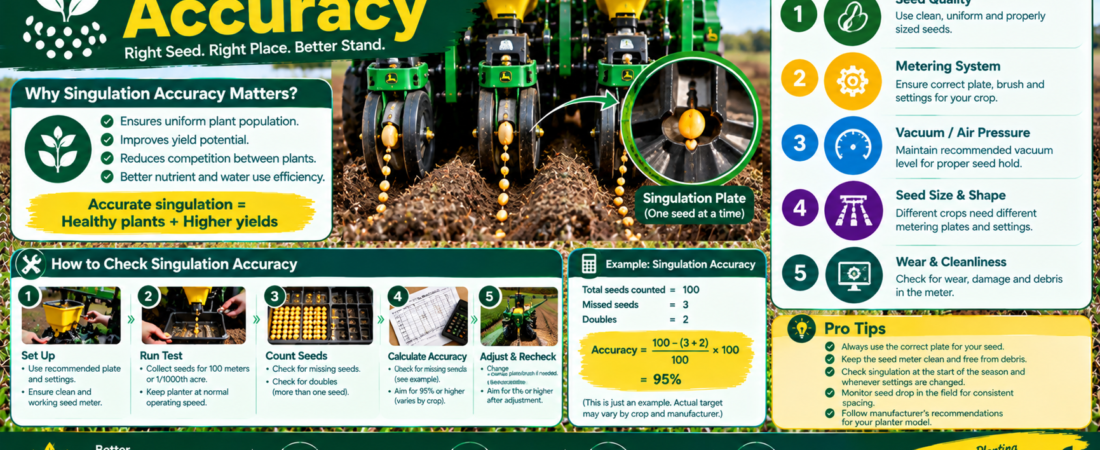
Singulation describes how well a planter meter delivers individual seeds at the intended spacing. Good singulation can support uniform placement, but the result also depends on seed quality, meter condition, speed, seed tubes, and field conditions.
Quick answer
The safest starting point for planter singulation accuracy is to use the exact machine and implement manuals, confirm the relevant measurements, and check the setup under the conditions in which the equipment will be used. Specifications can vary by model and configuration, so treat general explanations as guidance rather than a substitute for manufacturer instructions.
What singulation means
A singulation metric estimates how often the meter releases one seed rather than a multiple or skip. The display’s exact definition depends on the monitor and meter system.
For practical work, write down the model, configuration, and condition being checked. Compare like with like, and avoid assuming that a setting or measurement from another machine will transfer directly. If a specification is missing or unclear, contact the equipment manufacturer or a qualified dealer before operating outside the known limits.
Read the monitor correctly
Understand the difference between singulation, skips, multiples, population, and spacing variation. Check the operator manual for how each metric is calculated.
For practical work, write down the model, configuration, and condition being checked. Compare like with like, and avoid assuming that a setting or measurement from another machine will transfer directly. If a specification is missing or unclear, contact the equipment manufacturer or a qualified dealer before operating outside the known limits.
Seed and meter condition
Seed size, shape, treatment, dust, and lot variation can affect metering. Inspect discs, seals, brushes, singulators, and other parts according to the maker’s schedule.
For practical work, write down the model, configuration, and condition being checked. Compare like with like, and avoid assuming that a setting or measurement from another machine will transfer directly. If a specification is missing or unclear, contact the equipment manufacturer or a qualified dealer before operating outside the known limits.
Speed and vibration
Higher speed can challenge seed release and placement, depending on the planter and conditions. Use the approved operating range and observe performance as speed changes.
For practical work, write down the model, configuration, and condition being checked. Compare like with like, and avoid assuming that a setting or measurement from another machine will transfer directly. If a specification is missing or unclear, contact the equipment manufacturer or a qualified dealer before operating outside the known limits.
Seed tubes and placement
A well-metered seed can still be misplaced if the tube, delivery system, opener, closing wheels, or seedbed is not working correctly.
For practical work, write down the model, configuration, and condition being checked. Compare like with like, and avoid assuming that a setting or measurement from another machine will transfer directly. If a specification is missing or unclear, contact the equipment manufacturer or a qualified dealer before operating outside the known limits.
Make controlled adjustments
Change one setting at a time, use the manufacturer’s test procedure, and check actual seed placement. Do not assume the highest displayed score always means best emergence.
For practical work, write down the model, configuration, and condition being checked. Compare like with like, and avoid assuming that a setting or measurement from another machine will transfer directly. If a specification is missing or unclear, contact the equipment manufacturer or a qualified dealer before operating outside the known limits.
Use multiple measures of planting quality
Singulation is only one metric. Population, spacing, seed depth, seed-to-soil contact, and emergence also matter.
Understand system limits
Electronic displays may filter data or use system-specific definitions. Check the manual before comparing percentages across brands.
Practical example
If singulation drops when travel speed rises, compare meter settings, seed type, and the manufacturer’s recommended speed range before changing hardware or increasing vacuum.
This example explains the decision process; it is not a model-specific setting or a promise of performance. Use measured values from your own machine and follow the manufacturer’s approved procedure.
Common mistakes to avoid
Using a specification from a different model or configuration without checking compatibility.
Changing several settings at once, which makes it hard to identify the cause of a result.
Ignoring warning lights, damaged guards, leaks, unusual heat, or other signs that equipment needs inspection.
Assuming a display reading is correct without checking the sensor, inputs, calibration, or manual.
Step-by-step checklist
- Understand the monitor’s metric definitions.
- Use correct meter components for the seed lot.
- Inspect meters and seed tubes.
- Compare performance at approved speeds.
- Verify actual seed placement in the field.
Records that make the next job easier
Keep a short record of the machine model, implement model, date, operating conditions, measurements, settings, and any changes made. Note whether a value came from a manufacturer specification, a measurement, or an estimate. This distinction helps prevent an estimate from being mistaken for an official rating.
When the same task is repeated, compare records from similar conditions. A result from wet soil, a different crop, or another implement may not be a fair comparison. Records are also useful when another operator takes over the machine or when a dealer helps diagnose a problem.
Safety and maintenance notes
Park securely, shut down and isolate the machine before maintenance, and follow the operator manual. Do not use hands to locate hydraulic leaks or work near moving components. High-pressure fluid injuries require emergency medical attention.
Stop work if a guard is missing, a hose or fitting is damaged, a warning indicates a serious fault, or the machine behaves unexpectedly. Use qualified service for repairs that exceed your training, tools, or the manufacturer’s permitted operator maintenance.
Frequently asked questions
Is 100% singulation always possible?
The practical result depends on equipment, seed, and conditions; follow manufacturer guidance and assess overall planting quality.
Can speed affect singulation?
Yes. Speed can affect meter performance and seed delivery, depending on the planter system.
Does good singulation guarantee good emergence?
No. Seedbed, depth, moisture, seed quality, and closing performance also affect emergence.
Helpful resources
Start with the operator and service manuals for the exact machine and implement. General safety information is available from the U.S. Occupational Safety and Health Administration (OSHA), Penn State Extension, and eXtension’s agricultural safety resources. Use a specific official page that directly supports the point you are checking, and confirm the guidance applies to your equipment and location.
Explore more equipment and maintenance guides at AGRO Function.
How to use this guide
Use this article as a starting checklist, then verify details against the current manual. Machine generations can differ even when model names look similar. If the manual conflicts with a general article, follow the manufacturer’s instructions and contact its support team when needed.
For planter singulation accuracy, the practical question is not only what a specification says but also how it was measured and which configuration it describes. Write down the source of the value, its units, and any stated limits. This small habit makes future decisions easier to review and reduces the chance of comparing unlike machines.
What can change the result — field notes
The same setup can behave differently when the load, soil, crop, moisture, terrain, travel speed, temperature, or machine condition changes. Record those conditions whenever you compare results. This makes your notes more useful than a single number without context.
When to get expert help — planning notes
Ask a qualified technician or equipment dealer when a specification is missing, a safety system does not work, measurements are outside the stated range, or a repair involves pressure, stored energy, rotating parts, or structural components. Do not guess at a setting that could damage equipment or injure someone.
For planter singulation accuracy, the practical question is not only what a specification says but also how it was measured and which configuration it describes. Write down the source of the value, its units, and any stated limits. This small habit makes future decisions easier to review and reduces the chance of comparing unlike machines.
How to use this guide — verification tips
Use this article as a starting checklist, then verify details against the current manual. Machine generations can differ even when model names look similar. If the manual conflicts with a general article, follow the manufacturer’s instructions and contact its support team when needed.
What can change the result — record keeping
The same setup can behave differently when the load, soil, crop, moisture, terrain, travel speed, temperature, or machine condition changes. Record those conditions whenever you compare results. This makes your notes more useful than a single number without context.
For planter singulation accuracy, the practical question is not only what a specification says but also how it was measured and which configuration it describes. Write down the source of the value, its units, and any stated limits. This small habit makes future decisions easier to review and reduces the chance of comparing unlike machines.
When to get expert help
Ask a qualified technician or equipment dealer when a specification is missing, a safety system does not work, measurements are outside the stated range, or a repair involves pressure, stored energy, rotating parts, or structural components. Do not guess at a setting that could damage equipment or injure someone.
How to use this guide — field notes
Use this article as a starting checklist, then verify details against the current manual. Machine generations can differ even when model names look similar. If the manual conflicts with a general article, follow the manufacturer’s instructions and contact its support team when needed.
For planter singulation accuracy, the practical question is not only what a specification says but also how it was measured and which configuration it describes. Write down the source of the value, its units, and any stated limits. This small habit makes future decisions easier to review and reduces the chance of comparing unlike machines.
What can change the result — planning notes
The same setup can behave differently when the load, soil, crop, moisture, terrain, travel speed, temperature, or machine condition changes. Record those conditions whenever you compare results. This makes your notes more useful than a single number without context.
When to get expert help — verification tips
Ask a qualified technician or equipment dealer when a specification is missing, a safety system does not work, measurements are outside the stated range, or a repair involves pressure, stored energy, rotating parts, or structural components. Do not guess at a setting that could damage equipment or injure someone.
For planter singulation accuracy, the practical question is not only what a specification says but also how it was measured and which configuration it describes. Write down the source of the value, its units, and any stated limits. This small habit makes future decisions easier to review and reduces the chance of comparing unlike machines.
How to use this guide — record keeping
Use this article as a starting checklist, then verify details against the current manual. Machine generations can differ even when model names look similar. If the manual conflicts with a general article, follow the manufacturer’s instructions and contact its support team when needed.
What can change the result
The same setup can behave differently when the load, soil, crop, moisture, terrain, travel speed, temperature, or machine condition changes. Record those conditions whenever you compare results. This makes your notes more useful than a single number without context.
For planter singulation accuracy, the practical question is not only what a specification says but also how it was measured and which configuration it describes. Write down the source of the value, its units, and any stated limits. This small habit makes future decisions easier to review and reduces the chance of comparing unlike machines.
When to get expert help — field notes
Ask a qualified technician or equipment dealer when a specification is missing, a safety system does not work, measurements are outside the stated range, or a repair involves pressure, stored energy, rotating parts, or structural components. Do not guess at a setting that could damage equipment or injure someone.