
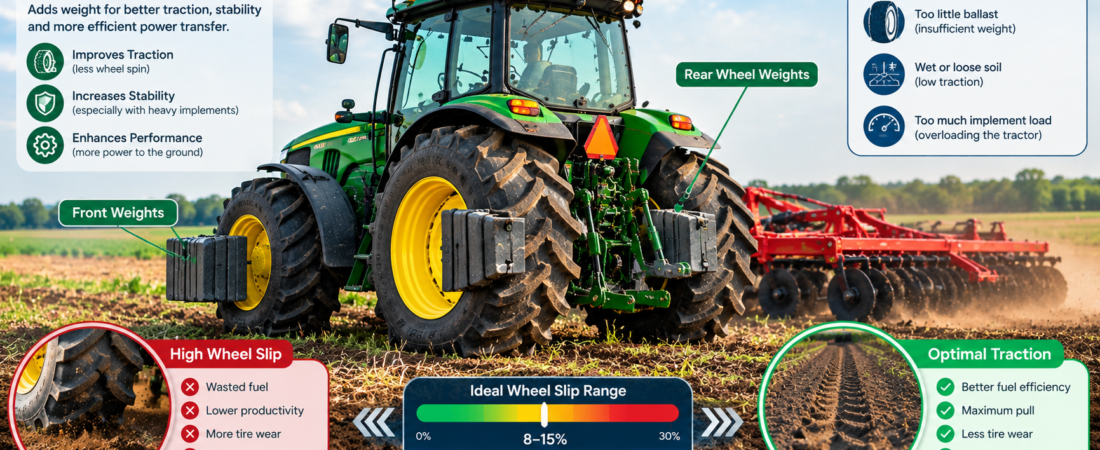
Tractor ballast helps transfer engine power to the ground, while wheel slip shows how much the drive tires rotate without moving the tractor forward. Correct setup can improve traction and reduce wasted effort, but too much weight can increase soil compaction and stress components.
Quick answer
The safest starting point for tractor ballast and wheel slip is to use the exact machine and implement manuals, confirm the relevant measurements, and check the setup under the conditions in which the equipment will be used. Specifications can vary by model and configuration, so treat general explanations as guidance rather than a substitute for manufacturer instructions.
What ballast does
Ballast is added or positioned weight used to improve balance and traction for a specific job. It may include approved wheel weights, front weights, or liquid ballast where permitted. The correct amount depends on tractor design, implement load, axle limits, and the job.
For practical work, write down the model, configuration, and condition being checked. Compare like with like, and avoid assuming that a setting or measurement from another machine will transfer directly. If a specification is missing or unclear, contact the equipment manufacturer or a qualified dealer before operating outside the known limits.
What wheel slip means
Some slip is normal when a driven tire works against soil. Too much slip can waste fuel, reduce field capacity, and wear tires. Too little slip is not automatically proof of ideal setup, because the correct range depends on tractor type, soil, and work.
For practical work, write down the model, configuration, and condition being checked. Compare like with like, and avoid assuming that a setting or measurement from another machine will transfer directly. If a specification is missing or unclear, contact the equipment manufacturer or a qualified dealer before operating outside the known limits.
Why soil and tires matter
Soil moisture, texture, residue, tire pressure, tread, and tire condition affect traction. A setup that works in firm soil may not perform the same in wet or loose ground. Follow the tire maker’s load and pressure tables.
For practical work, write down the model, configuration, and condition being checked. Compare like with like, and avoid assuming that a setting or measurement from another machine will transfer directly. If a specification is missing or unclear, contact the equipment manufacturer or a qualified dealer before operating outside the known limits.
Ballast for different jobs
Heavy drawbar work can need a different weight distribution from loader work or light transport. Front-end loaders create changing loads and can affect stability. Use the tractor manufacturer’s ballast recommendations for the specific configuration.
For practical work, write down the model, configuration, and condition being checked. Compare like with like, and avoid assuming that a setting or measurement from another machine will transfer directly. If a specification is missing or unclear, contact the equipment manufacturer or a qualified dealer before operating outside the known limits.
Measuring and adjusting carefully
If the tractor has a wheel-slip display, understand how it estimates slip and whether calibration is needed. Otherwise, use a manufacturer-approved measurement method. Make one adjustment at a time and compare performance under similar conditions.
For practical work, write down the model, configuration, and condition being checked. Compare like with like, and avoid assuming that a setting or measurement from another machine will transfer directly. If a specification is missing or unclear, contact the equipment manufacturer or a qualified dealer before operating outside the known limits.
Avoid compaction and unsafe loading
More weight is not always better. Excess mass can increase soil compaction, rolling resistance, and axle loads. Never exceed gross vehicle, axle, tire, or hitch ratings, and do not use improvised ballast.
For practical work, write down the model, configuration, and condition being checked. Compare like with like, and avoid assuming that a setting or measurement from another machine will transfer directly. If a specification is missing or unclear, contact the equipment manufacturer or a qualified dealer before operating outside the known limits.
Measure before changing weight
Compare wheel slip or traction under repeatable conditions and check implement depth and tire setup. Changing several variables at once makes it difficult to identify what improved performance.
Loader work needs special care
Front loaders can shift the center of gravity and place loads on the front axle. Use approved counterweights, stay within loader and tractor ratings, and carry loads low during travel as instructed.
Practical example
If the tractor spins excessively during a consistent tillage pass, first check tire pressure, tire condition, implement depth, and soil conditions. Only then consider ballast changes using the operator manual.
This example explains the decision process; it is not a model-specific setting or a promise of performance. Use measured values from your own machine and follow the manufacturer’s approved procedure.
Common mistakes to avoid
Using a specification from a different model or configuration without checking compatibility.
Changing several settings at once, which makes it hard to identify the cause of a result.
Ignoring warning lights, damaged guards, leaks, unusual heat, or other signs that equipment needs inspection.
Assuming a display reading is correct without checking the sensor, inputs, calibration, or manual.
Step-by-step checklist
- Identify the tractor’s approved ballast range for the task.
- Check tire pressure against load and tire tables.
- Inspect tread and account for soil moisture and residue.
- Measure slip using an approved method if possible.
- Stay within axle, tire, hitch, and total weight ratings.
Records that make the next job easier
Keep a short record of the machine model, implement model, date, operating conditions, measurements, settings, and any changes made. Note whether a value came from a manufacturer specification, a measurement, or an estimate. This distinction helps prevent an estimate from being mistaken for an official rating.
When the same task is repeated, compare records from similar conditions. A result from wet soil, a different crop, or another implement may not be a fair comparison. Records are also useful when another operator takes over the machine or when a dealer helps diagnose a problem.
Safety and maintenance notes
Park securely, shut down and isolate the machine before maintenance, and follow the operator manual. Do not use hands to locate hydraulic leaks or work near moving components. High-pressure fluid injuries require emergency medical attention.
Stop work if a guard is missing, a hose or fitting is damaged, a warning indicates a serious fault, or the machine behaves unexpectedly. Use qualified service for repairs that exceed your training, tools, or the manufacturer’s permitted operator maintenance.
Frequently asked questions
Does adding ballast always reduce wheel slip?
Not always. The result depends on weight distribution, tires, soil, and load. Excess weight can increase compaction and resistance.
Can I use the same ballast for every implement?
No. Different implements and jobs change load distribution and traction requirements.
Is wheel slip the same as tire pressure?
No. Slip describes tire rotation relative to forward movement; pressure affects tire shape, contact, and load capacity.
Helpful resources
Start with the operator and service manuals for the exact machine and implement. General safety information is available from the U.S. Occupational Safety and Health Administration (OSHA), Penn State Extension, and eXtension’s agricultural safety resources. Use a specific official page that directly supports the point you are checking, and confirm the guidance applies to your equipment and location.
Explore more equipment and maintenance guides at AGRO Function.
How to use this guide
Use this article as a starting checklist, then verify details against the current manual. Machine generations can differ even when model names look similar. If the manual conflicts with a general article, follow the manufacturer’s instructions and contact its support team when needed.
For tractor ballast and wheel slip, the practical question is not only what a specification says but also how it was measured and which configuration it describes. Write down the source of the value, its units, and any stated limits. This small habit makes future decisions easier to review and reduces the chance of comparing unlike machines.
What can change the result — field notes
The same setup can behave differently when the load, soil, crop, moisture, terrain, travel speed, temperature, or machine condition changes. Record those conditions whenever you compare results. This makes your notes more useful than a single number without context.
When to get expert help — planning notes
Ask a qualified technician or equipment dealer when a specification is missing, a safety system does not work, measurements are outside the stated range, or a repair involves pressure, stored energy, rotating parts, or structural components. Do not guess at a setting that could damage equipment or injure someone.
For tractor ballast and wheel slip, the practical question is not only what a specification says but also how it was measured and which configuration it describes. Write down the source of the value, its units, and any stated limits. This small habit makes future decisions easier to review and reduces the chance of comparing unlike machines.
How to use this guide — verification tips
Use this article as a starting checklist, then verify details against the current manual. Machine generations can differ even when model names look similar. If the manual conflicts with a general article, follow the manufacturer’s instructions and contact its support team when needed.
What can change the result — record keeping
The same setup can behave differently when the load, soil, crop, moisture, terrain, travel speed, temperature, or machine condition changes. Record those conditions whenever you compare results. This makes your notes more useful than a single number without context.
For tractor ballast and wheel slip, the practical question is not only what a specification says but also how it was measured and which configuration it describes. Write down the source of the value, its units, and any stated limits. This small habit makes future decisions easier to review and reduces the chance of comparing unlike machines.
When to get expert help
Ask a qualified technician or equipment dealer when a specification is missing, a safety system does not work, measurements are outside the stated range, or a repair involves pressure, stored energy, rotating parts, or structural components. Do not guess at a setting that could damage equipment or injure someone.
How to use this guide — field notes
Use this article as a starting checklist, then verify details against the current manual. Machine generations can differ even when model names look similar. If the manual conflicts with a general article, follow the manufacturer’s instructions and contact its support team when needed.
For tractor ballast and wheel slip, the practical question is not only what a specification says but also how it was measured and which configuration it describes. Write down the source of the value, its units, and any stated limits. This small habit makes future decisions easier to review and reduces the chance of comparing unlike machines.
What can change the result — planning notes
The same setup can behave differently when the load, soil, crop, moisture, terrain, travel speed, temperature, or machine condition changes. Record those conditions whenever you compare results. This makes your notes more useful than a single number without context.
When to get expert help — verification tips
Ask a qualified technician or equipment dealer when a specification is missing, a safety system does not work, measurements are outside the stated range, or a repair involves pressure, stored energy, rotating parts, or structural components. Do not guess at a setting that could damage equipment or injure someone.
For tractor ballast and wheel slip, the practical question is not only what a specification says but also how it was measured and which configuration it describes. Write down the source of the value, its units, and any stated limits. This small habit makes future decisions easier to review and reduces the chance of comparing unlike machines.
How to use this guide — record keeping
Use this article as a starting checklist, then verify details against the current manual. Machine generations can differ even when model names look similar. If the manual conflicts with a general article, follow the manufacturer’s instructions and contact its support team when needed.
What can change the result
The same setup can behave differently when the load, soil, crop, moisture, terrain, travel speed, temperature, or machine condition changes. Record those conditions whenever you compare results. This makes your notes more useful than a single number without context.
For tractor ballast and wheel slip, the practical question is not only what a specification says but also how it was measured and which configuration it describes. Write down the source of the value, its units, and any stated limits. This small habit makes future decisions easier to review and reduces the chance of comparing unlike machines.
When to get expert help — field notes
Ask a qualified technician or equipment dealer when a specification is missing, a safety system does not work, measurements are outside the stated range, or a repair involves pressure, stored energy, rotating parts, or structural components. Do not guess at a setting that could damage equipment or injure someone.
How to use this guide — planning notes
Use this article as a starting checklist, then verify details against the current manual. Machine generations can differ even when model names look similar. If the manual conflicts with a general article, follow the manufacturer’s instructions and contact its support team when needed.
For tractor ballast and wheel slip, the practical question is not only what a specification says but also how it was measured and which configuration it describes. Write down the source of the value, its units, and any stated limits. This small habit makes future decisions easier to review and reduces the chance of comparing unlike machines.
What can change the result — verification tips
The same setup can behave differently when the load, soil, crop, moisture, terrain, travel speed, temperature, or machine condition changes. Record those conditions whenever you compare results. This makes your notes more useful than a single number without context.
When to get expert help — record keeping
Ask a qualified technician or equipment dealer when a specification is missing, a safety system does not work, measurements are outside the stated range, or a repair involves pressure, stored energy, rotating parts, or structural components. Do not guess at a setting that could damage equipment or injure someone.
For tractor ballast and wheel slip, the practical question is not only what a specification says but also how it was measured and which configuration it describes. Write down the source of the value, its units, and any stated limits. This small habit makes future decisions easier to review and reduces the chance of comparing unlike machines.
How to use this guide
Use this article as a starting checklist, then verify details against the current manual. Machine generations can differ even when model names look similar. If the manual conflicts with a general article, follow the manufacturer’s instructions and contact its support team when needed.
What can change the result — field notes
The same setup can behave differently when the load, soil, crop, moisture, terrain, travel speed, temperature, or machine condition changes. Record those conditions whenever you compare results. This makes your notes more useful than a single number without context.
For tractor ballast and wheel slip, the practical question is not only what a specification says but also how it was measured and which configuration it describes. Write down the source of the value, its units, and any stated limits. This small habit makes future decisions easier to review and reduces the chance of comparing unlike machines.
When to get expert help — planning notes
Ask a qualified technician or equipment dealer when a specification is missing, a safety system does not work, measurements are outside the stated range, or a repair involves pressure, stored energy, rotating parts, or structural components. Do not guess at a setting that could damage equipment or injure someone.
How to use this guide — verification tips
Use this article as a starting checklist, then verify details against the current manual. Machine generations can differ even when model names look similar. If the manual conflicts with a general article, follow the manufacturer’s instructions and contact its support team when needed.
For tractor ballast and wheel slip, the practical question is not only what a specification says but also how it was measured and which configuration it describes. Write down the source of the value, its units, and any stated limits. This small habit makes future decisions easier to review and reduces the chance of comparing unlike machines.
What can change the result — record keeping
The same setup can behave differently when the load, soil, crop, moisture, terrain, travel speed, temperature, or machine condition changes. Record those conditions whenever you compare results. This makes your notes more useful than a single number without context.
When to get expert help
Ask a qualified technician or equipment dealer when a specification is missing, a safety system does not work, measurements are outside the stated range, or a repair involves pressure, stored energy, rotating parts, or structural components. Do not guess at a setting that could damage equipment or injure someone.
For tractor ballast and wheel slip, the practical question is not only what a specification says but also how it was measured and which configuration it describes. Write down the source of the value, its units, and any stated limits. This small habit makes future decisions easier to review and reduces the chance of comparing unlike machines.